By Melissa Brown, OTR/L, RAC-CT, CSRS, CDP · Chief Operating Officer, Gravity Consulting
Last week a client sent me a short question about the new respiratory therapy language. Were they reading it right, and did it mean the RT they had been coding would no longer count?
It’s a fair question, and I expect many MDS coordinators, NHAs and DONs are asking it this week. CMS posted the final MDS 3.0 RAI User’s Manual, version 1.20.11, on September 17. It took effect October 1, 2026, the first day of FY 2027.
No items were added to or removed from the MDS this year. What changed is the guidance around them: coding instructions, coding tips and examples. That still changes what your documentation has to show.
Two of the October 2026 MDS changes need leadership attention now. The first is respiratory therapy (RT), where CMS now draws a clear line between skilled and prophylactic RT. The second is a clarification that states and payers cannot change how federal MDS items are coded. The full list of changes is summarized in a table further down.
Respiratory therapy: prophylactic is out, skilled is in
The short answer to my client: generic prophylactic RT should no longer be coded on the MDS. RT that is clinically necessary, delivered with skilled judgment and documented as benefiting the resident still counts.
What the manual now says
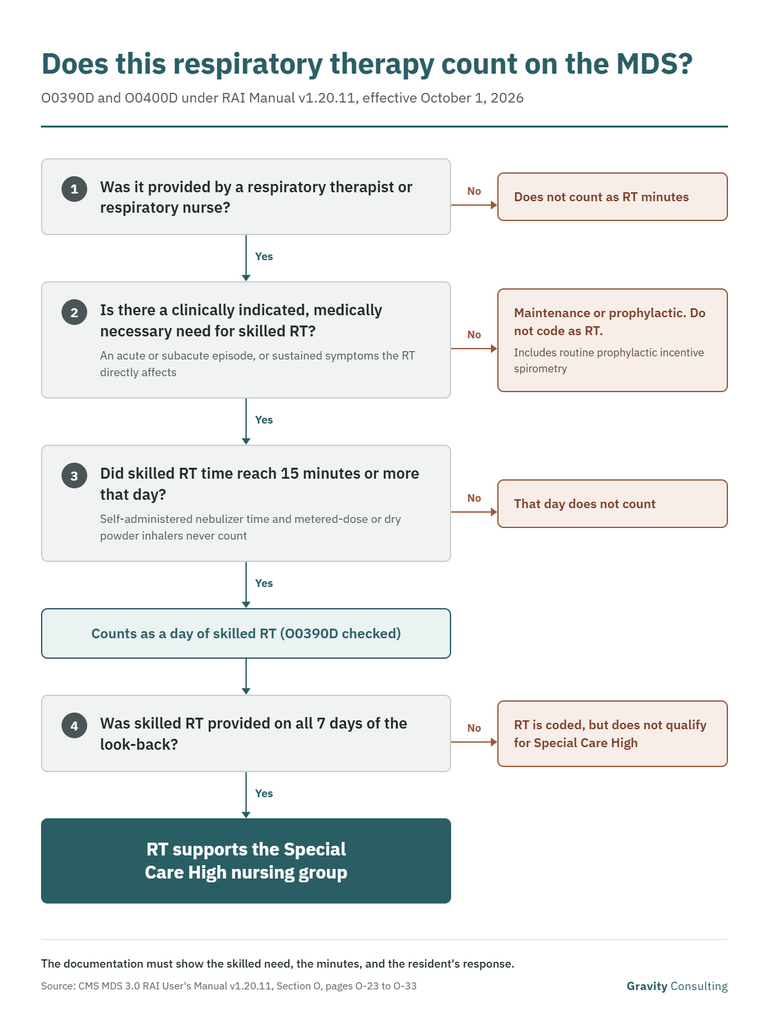
- Who still counts. Only minutes a respiratory therapist or respiratory nurse spends with the resident count toward the 15-minute day for O0390D, providing skilled and medically necessary RT. That includes evaluation, treatment administration and monitoring, and equipment setup and removal.
- What doesn’t. Time a resident self-administers or receives a nebulizer treatment, or “maintenance level/prophylactic incentive spirometry without clinically indicated or medically necessary supervision,” is excluded. Metered-dose and dry powder inhalers never counted (page O-23).
- Skilled is about judgment, not the device. The therapy modalities guidance now names prophylactic incentive spirometry as often not skilled. When the resident’s condition is complicated and truly requires the clinician’s skills, those minutes can be recorded (page O-32), but that explanation needs to be clearly drawn out in the documentation.
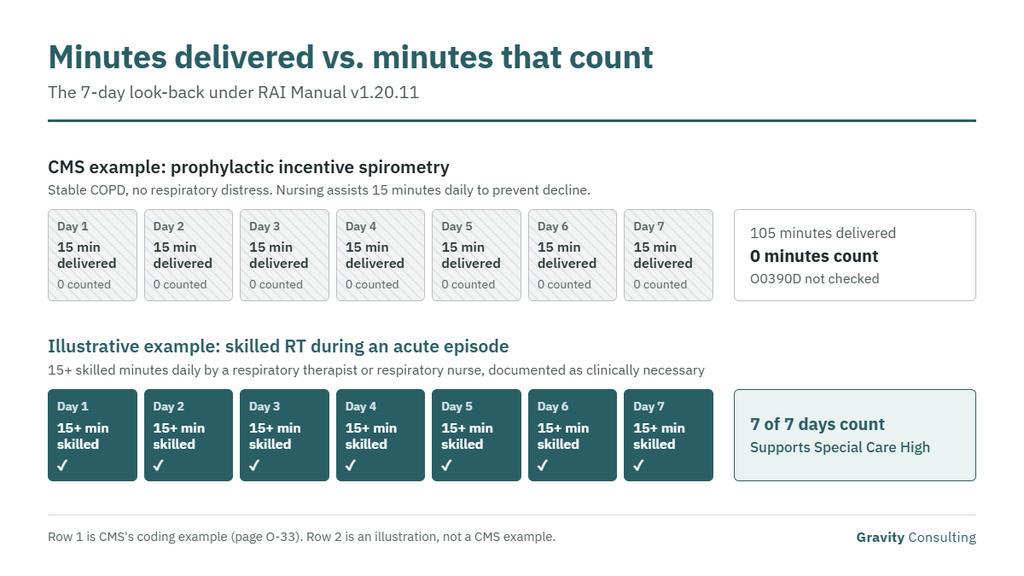
- The spirometer example. A new coding example describes a resident with stable COPD and no respiratory distress, ordered daily incentive spirometry to prevent decline. Nursing assisted for 15 minutes every day of the look-back. O0390D is not checked, because the treatment did not require the skills of a respiratory therapist or respiratory nurse (page O-33).
What it takes to qualify for Special Care High
Under PDPM, respiratory therapy qualifies a resident for the Special Care High nursing group only when it is provided on all seven days of the look-back and you can demonstrate through the documentation and medical evaluations that the resident required the treatment, it was not prophylactic in nature, and the services required the skill of a respiratory therapist or respiratory nurse.
In states that have moved Medicaid case mix to PDPM, the same nursing classification can carry into the Medicaid rate as well.
How we’re interpreting it at Gravity
Here is what I told my client about CMS’s new language, nearly word for word:
Because they speak specifically about prophylactic RT measures not being counted as RT, I would not use prophylactic RT as an item for the MDS or for PDPM. It appears that they are saying that utilization of RT should be for acute or subacute episodes, or with sustained symptoms that are directly impacted by the RT. The example they give is specifically about the spirometer but could be applied to other prophylactic RT.
The key here is to use clinical necessity and medical benefit as our guide. If it is clearly benefiting the resident and we can prove that in the documentation, then it is possible to be captured as RT. But generic prophylactic use of the spirometer for all or most patients is clearly excluded.
My advice is to treat RT the way you already treat restorative nursing and PT, OT and speech. The manual has drawn the line between skilled and maintenance care for rehab for years. RT now sits on the same line.
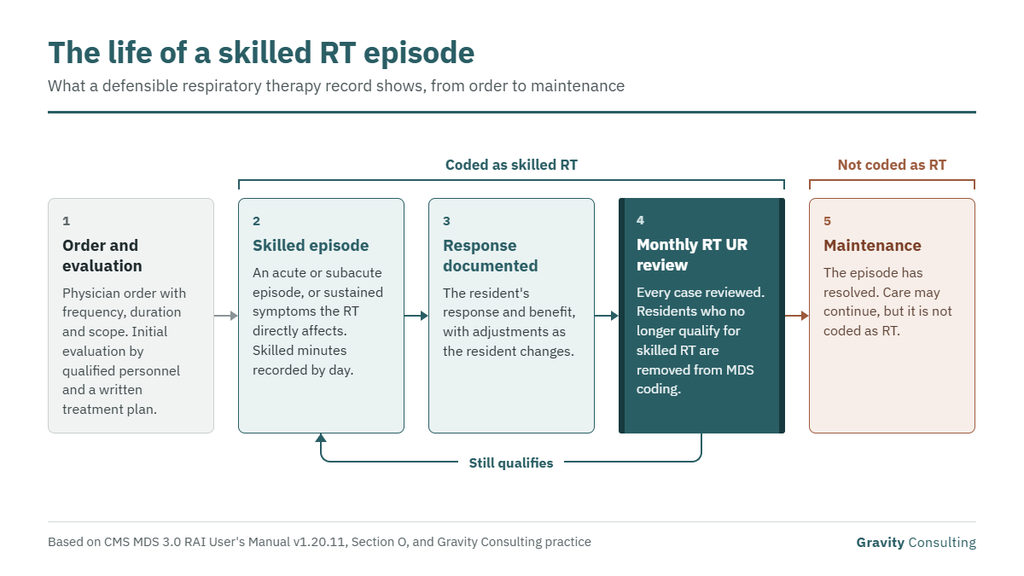
What a defensible RT record shows
- A physician order stating the frequency, duration and scope of treatment.
- An initial evaluation by qualified personnel, and a written treatment plan the RT ties back to.
- A clinical reason skilled RT is needed now: an acute or subacute episode, or sustained symptoms the RT directly affects.
- Minutes from a respiratory therapist or respiratory nurse, counting only skilled time, recorded by day.
- The resident’s response and the benefit, with adjustments as the resident changes.
- A clear point where the episode resolves and the care becomes maintenance. From then on, it is not coded as RT. This is often best achieved with a monthly RT UR meeting where every case is reviewed and residents that no longer qualify for skilled RT are removed from MDS coding.
What to check this week
- Admission order sets or protocols that add incentive spirometry prophylactically, with the expectation of capturing it as skilled RT on the MDS.
- Residents currently in Special Care High where RT is the only qualifier.
- Who reviews RT documentation against these criteria before the ARD.
- Whether nursing staff providing RT meet the manual’s definition of a respiratory nurse (Appendix A glossary).
This lands in a year when CMS is watching coding closely. In the FY 2027 SNF PPS final rule, CMS summarized comments on case-mix growth it attributes to coding rather than resident acuity. It did not finalize a PDPM change, but said the feedback may inform future rulemaking. Accurate RT capture protects the rate your residents’ care actually supports.
States can’t rewrite federal MDS coding, and that creates a gap
CMS added language to Chapters 1, 2 and 3 of the manual: state or payer requirements do not replace, modify or add to CMS coding requirements for items outside Section S. Section S is still where state-specific items live. States can also add federal items to their quarterly or PPS assessments, but those items are still coded by CMS instructions.
On paper, that is simple: code federal items the way the RAI Manual says. In practice, providers still have to comply with their state’s regulations. Where a state rule asks for something different on a federal item, providers are in limbo until the state clarifies how to comply with both.
What to do until your state clarifies
- List every state-specific instruction your team applies to a federal MDS item.
- Code federal items to the RAI Manual.
- Keep any state-required documentation that doesn’t change the coding.
- Where a real conflict exists, put the question to your state RAI coordinator in writing and keep the answer on file. Coordinators are listed in Appendix B of the manual, updated August 2026.
- If you operate in more than one state, hold every building to one federal coding standard and track state requirements separately.
In the meantime, watch your state RAI coordinator and Medicaid agency for guidance.
Every October 1 change at a glance
The table below covers the full release, including the RT change above, so your team can use it as a reference.
| Area | What changed effective 10/1/26 | Who needs to know |
|---|---|---|
| BIMS – Section C / PHQ-2 to 9 – Section D | When more than one resident interview is completed during the applicable look-back period, use the interview completed closest to the ARD for MDS coding. | MDS, Social Services, Therapy |
| A1005 / A1010 – Ethnicity and Race | Updated reassessment guidance allows a prior resident response to be used when the resident was asked within the prior year; after one year, the resident should be asked again. | Admissions, MDS |
| J1100 – Shortness of Breath While Lying Flat | CMS clarified that staff should not require the resident to perform an activity or position solely to confirm shortness of breath when the resident reports avoiding it because it causes symptoms. Chapter 6 terminology was also aligned with asthma, COPD, or chronic lung disease in the Special Care High discussion. | Nursing, MDS |
| J1800 – Falls | CMS clarified the assessment period for falls, including how the look-back is determined following a reentry. For a reentry assessment, the review period begins with the reentry date and continues through the ARD. | Nursing, MDS |
| Section M – Pressure Ulcers/Injuries Present on Admission | Guidance was revised for a pressure ulcer/injury that was present on admission, subsequently heals, and later reopens. Once fully healed, a later reopening is treated as a new occurrence for present-on-admission coding purposes. | Wound Nurse, Nursing, MDS |
| Section M – Advanced Wound Care / Surgical Wounds | CMS added/refined guidance regarding advanced wound-care dressings and skin substitutes. Their use does not, by itself, cause a pressure ulcer/injury to be coded as a surgical wound. Surgical treatment such as excision with flap or graft closure may change the wound classification. | Wound Nurse, Nursing, MDS |
| Section M – Adhesive Bandages / Closure Strips | CMS added/refined guidance regarding adhesive bandages and wound-closure strips in Section M. These should not be treated as qualifying dressings merely because they cover or approximate a wound. | Wound Nurse, MDS |
| O0110M1 – Isolation | CMS refined the isolation coding criteria and examples. The long-standing requirement that all applicable isolation conditions be met remains; the FY 2027 change is clarification/refinement of the guidance. | Infection Prevention, Nursing, MDS |
| Section O – Skilled Respiratory Therapy | CMS refined what qualifies as skilled respiratory therapy and what treatment time can be counted. Only qualifying skilled services actively provided by appropriate staff count; self-administered or unsupervised treatment time does not. | Respiratory Therapy, Nursing, MDS |
| Chapter 2 – Transfers During a Public Health Emergency | New guidance addresses resident transfers and assessment requirements during a public health emergency or emergency waiver situation. | Administrator, MDS, Emergency Preparedness |
| Chapter 6 – Depression Terminology | Terminology was revised to refer to “signs and symptoms of depression.” This is a terminology clarification and does not change the underlying PDPM classification logic. | MDS, Nursing |
| Chapter 6 – Restorative Toileting Programs | CMS clarified that toileting programs under H0200C/H0500 do not require the same documentation of days and minutes that applies to restorative nursing programs subject to the 15-minute requirement. | MDS, Restorative Nursing |
The BIMS and PHQ timing rule is the one most likely to change daily routines. The BIMS feeds both the PDPM speech-language pathology and nursing components, and the PHQ feeds the nursing depression split. Someone needs to own which interview counts and make sure the MDS coordinator has it before the assessment is finalized.
How Gravity helps
Gravity reviews MDS coding against the current RAI Manual, trains MDS and nursing staff, and repairs the workflow behind each assessment: who documents what, and who checks it before the ARD. When a building loses its MDS coordinator, we provide interim coverage. In PDPM Medicaid states, we help operators see how coding flows through to their Medicaid rate.
I’ll also be covering reimbursement protection at LeadingAge Annual in Philadelphia on October 25, in my session “From Minutes to Medicine: Protecting Your Reimbursement.”
If the RT language or the state clarification has raised questions for your team, start the conversation.
Frequently asked questions
Does prophylactic incentive spirometry count as respiratory therapy on the MDS? Not on its own. As of October 1, 2026, maintenance-level or prophylactic incentive spirometry without clinically indicated or medically necessary supervision by a respiratory therapist or respiratory nurse is excluded. It can count when the resident’s condition requires skilled judgment and the documentation shows it.
Which RAI Manual version took effect October 1, 2026? The MDS 3.0 RAI User’s Manual version 1.20.11, posted by CMS on September 17, 2026.
Did the MDS item set change in October 2026? No items were added or removed. The changes are to guidance, coding instructions, coding tips and examples.
Can a state require different coding for a federal MDS item? No. CMS clarified that state or payer requirements do not replace, modify or add to CMS coding requirements for items outside Section S.
Does respiratory therapy still qualify a resident for Special Care High? Yes, when skilled RT is provided for at least 15 minutes a day on all seven days of the look-back and the record supports it.
If more than one BIMS is completed in the look-back, which one is coded? The interview closest to the ARD. The same rule applies to the PHQ-2 to 9.