In a lot of senior living communities, one kitchen serves two very different menus. Independent living gets the chef’s specials, and assisted living gets whatever the budget left behind. That’s backwards: assisted living residents are the ones whose health, function and length of stay depend most on what’s on the plate.
Operators who treat food as medicine in assisted living are finding that the numbers make a stronger case than most budgets assume. On this episode of Senior Living Executive Strategy, Gravity COO Melissa Brown talks with Matt Henney of Metz Culinary Management about how to make that shift, even when margins are tight.
Why Assisted Living Dining Gets Squeezed First
When a project’s costs come in high, dining is usually the first operating line to give. It’s treated as a department cost rather than part of the care model or the sales pitch.
The pressure is real. Assisted living occupancy reached 88.4% in the second quarter of 2026, still behind independent living at 91.3%. Assisted living hard costs run $278 to $356 per square foot at a mid-level finish, and every dollar spent on the building is a dollar the operating budget can’t spend on the plate.
On the podcast, Melissa described a luxury client community serving incredible food in independent living and a different, lesser menu in assisted living, all from the same kitchen. The leader there told her she wished food had been built into the project from day one, because by opening there was no margin left. Gravity designed its own assisted living projects the other way around: non-traditional construction, such as office and historic property conversions, keeps costs well under $300,000 per unit and leaves room to invest in dining.
For most executives, the squeeze shows up as a familiar set of problems:
- A food cost per resident day that gets cut every budget cycle, with no line connecting it to census or outcomes
- Two quality tiers coming out of one kitchen, which residents and families notice
- Dining complaints that surface in move-out conversations and online reviews
- Weight loss and nutrition concerns that land on nursing, not dining
Dining Is a Buying Decision, for Residents and Adult Children
Food quality is one of the first things prospects weigh, and most of them don’t expect senior living to deliver it. That gap is an opening for any community willing to close it.
In a 2024 survey of 1,485 adults ages 55 to 96, 69% rated food quality as very important to choosing a community. Only 17% were very confident senior living could deliver the variety they expect, and just 11% associated restaurant-quality food with senior living at all. In a separate survey, 87% of people planning a move within two years said they were actively weighing the dining experience as they decided where to live.
The expectations are also shifting. As Matt Henney points out in the episode, the residents moving into assisted living now are the generation that made sushi and Cantonese food mainstream in America. A meat-and-potatoes menu was built for their parents.
Adult children are part of this sale too. They often drive the decision, and many carry real guilt about it. A family that tours the dining room and sees fresh, scratch-made food their parent will actually eat leaves with one less reason to worry, and one more reason to choose you.
The Retention Math: Where Better Food Pays for Itself
In assisted living, revenue is earned one resident day at a time, so small improvements in length of stay can fund a better dining program. The math is simpler than most budgets make it look.
The typical assisted living stay is about 22 months, a figure long cited from the National Center for Assisted Living. The 2025 national median assisted living rate is $6,200 a month, or $204 a day. At that rate, here’s how many extra days of stay it takes to cover a richer food budget:
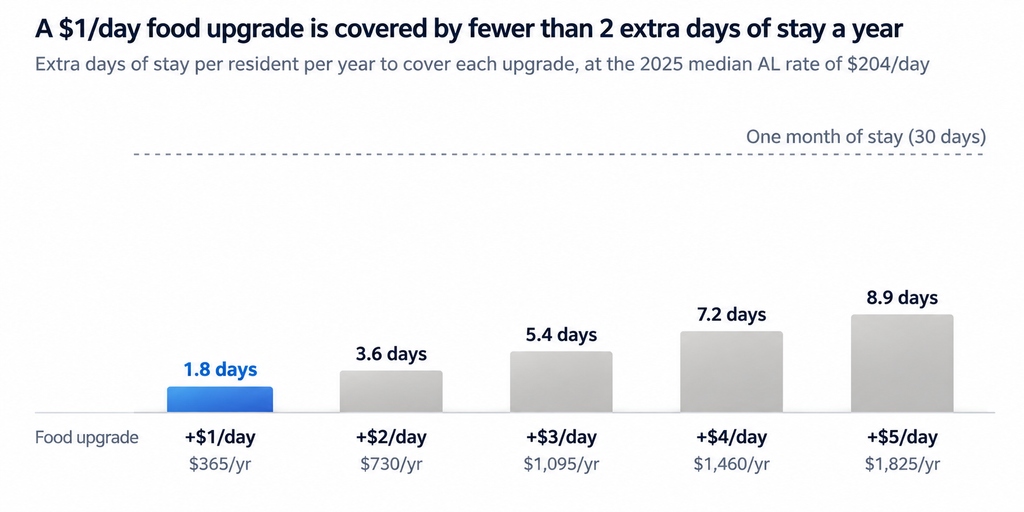
Even a $5 per resident day increase, which changes what a kitchen can buy and how much it can cook from scratch, is covered by about nine extra days of stay a year. That’s less than 2% of a typical 22-month stay.
Move-outs make the case even stronger. Every vacant day costs the full daily rate, so a unit that sits empty for 30 days loses about $6,100 before any marketing, turnover or move-in costs. As Matt puts it in the episode, residents who are unhappy with the food may simply leave and go next door. Losing one resident over dining can cost more than a year of upgraded food for that resident.
The Clinical Cost Hiding in the Dining Room: Malnutrition and Dysphagia
Poor nutrition in senior living is common, often undiagnosed, and expensive once it shows up as weight loss, falls or a hospital transfer. Dining is where it either gets prevented or gets worse.
In one study, 44% of assisted living residents seen in the emergency department showed signs of malnutrition, and more than three-quarters of older patients who were malnourished or at risk had never been diagnosed. The leading contributors weren’t dementia or critical illness. They were depression, dental problems, trouble getting groceries and swallowing issues, all of which a dining program and care team can spot.
Swallowing problems are even more widespread in skilled nursing. A meta-analysis found dysphagia in more than half of nursing home residents when validated screening tools were used. In a European study, residents with dysphagia had 58% higher odds of dying within a year, and 91% of them were on texture-modified diets.
That last number is the operational point. If nine in ten residents with dysphagia eat pureed or modified food, the quality of that food decides whether they eat at all. Matt shared a personal example in the episode: his aunt, living with ALS, had been losing weight steadily until well-made pureed meals became the one thing she could and would eat, and her weight stopped dropping.
For skilled nursing operators, there’s a reimbursement link too. Under PDPM, the speech-language pathology payment component uses swallowing disorders and mechanically altered diets, both captured in Section K of the MDS. When the SLP, nursing and dining teams aren’t talking, a real swallowing need can go undocumented. The goal is accurate capture of clinical need, never prescribing a diet for payment, which CMS specifically monitors.
Readmissions: What Skilled Nursing Can Learn From Post-Discharge Meals
For a skilled nursing facility, a patient’s first weeks at home count against you, and nutrition is one of the few levers that reaches into that kitchen. Medically tailored meals are now some of the best-studied tools for keeping people out of the hospital.
Heart failure shows the stakes. In Medicare data from 2007 to 2009, 24.8% of heart failure patients were readmitted within 30 days, and more than 30% of those readmissions happened between days 16 and 30. The risk doesn’t end after the first week home.
The evidence for meals is getting stronger:
- In a study published in Nature Medicine in June 2026, Massachusetts Medicaid members who received medically tailored meals had 31% fewer hospitalizations and 20% fewer emergency visits than members who didn’t.
- In a randomized trial of 206 adults with heart failure, eight weeks of medically tailored meals cut heart failure hospitalizations from 13.0% to 3.8%.
- An earlier Massachusetts study linked medically tailored meals to fewer hospital and skilled nursing admissions and lower overall medical spending.
The financial exposure for SNFs is direct. The SNF Value-Based Purchasing program withholds 2% of Medicare Part A payments and returns only 60% of that pool as incentives. CMS estimates VBP will reduce aggregate SNF payments by $203.6 million in FY 2027. And a short-stay patient who goes home and is readmitted within the 30-day window still counts against the facility.
Metz’s Chef to Home program, which Matt describes in the episode, sends patients home with a week of medically tailored meals, such as lower-sodium, higher-protein cardiac meals. Metz is seeing strong early readmission results on the cardiac side, though Matt was clear the case study is still in progress and numbers aren’t published yet.
Even without a meal program, SNFs can ask a better discharge question: who is cooking for this patient next week? Melissa put it plainly on the podcast. For someone going home alone, making a meal may be the hardest thing they do all day. That makes meal preparation a real occupational therapy goal, and a real part of the discharge plan.
Where to Start When the Budget Is Tight
Food as medicine doesn’t have to be all or nothing. As Matt puts it, higher-quality ingredients don’t automatically mean higher cost; it depends on how the menu is built. These are practical first moves, several straight from the episode.
- Fix the snacks first. Swap cookies, graham crackers and sugary chocolate milk for yogurt, cottage cheese, and vegetables with hummus, the snacks today’s residents ate at home.
- Use stealth nutrition. Build nutrition into dishes residents already love, like cauliflower blended into macaroni and cheese, without changing the name on the menu.
- Set a scratch-cooking target. Matt suggests 85% to 90% scratch as a realistic goal, since a supply chain makes 100% hard. Start with high-visibility items like lasagna or baked goods.
- Close the assisted living gap one meal at a time. If independent living gets the better menu, bring one meal period in assisted living up to that standard and expand from there.
- Treat texture-modified food as a priority. Pureed and mechanically altered meals should be ones residents want to eat, not just ones they’re allowed to eat.
- Put dining at the clinical table. Review weight trends, swallowing changes and meal intake with dining, nursing and therapy together.
- Measure what it’s worth. Track weight trends, dining satisfaction, hospital transfers, move-out reasons and length of stay, so the next budget conversation is about results, not cost per plate.
How Gravity Helps
Gravity Consulting is building food as medicine into its own assisted living projects, so we approach dining the way an operator does: as part of the care model, the sales process and the budget at the same time. Here’s where we typically come in.
| If this is the problem | How Gravity helps |
|---|---|
| Assisted living dining is a cost line with no clear return | We evaluate your dining program and food service vendors, set realistic quality and scratch-cooking standards, and tie dining to census, retention and length of stay |
| You’re choosing or renegotiating a dining vendor | We help define what the contract should require, compare vendors on ingredients, staffing and clinical support, and hold the program to it after it starts |
| Residents are losing weight or struggling with modified diets | Our therapy team builds speech and occupational therapy programming for swallowing, self-feeding and meal preparation, focused on function and medical necessity |
| Swallowing needs aren’t showing up correctly on the MDS | MDS and PDPM audits check that Section K and related items reflect the clinical picture, so care plans and reimbursement match the patient |
| Readmissions are hurting your SNF VBP score | We tighten discharge planning, IDT and QAPI processes so nutrition and meal access are part of every safe discharge |
| You’re developing or repositioning a community | We help owners and developers build an operating model where dining is planned and funded from the start, not cut at the end |
If any of these sound familiar, start the conversation.
Frequently Asked Questions
What does “food as medicine” mean in senior living?
Food as medicine means treating meals as part of each resident’s care plan, not just a hospitality service. In practice, that covers ingredient quality, sodium, saturated fat and protein targets, texture-modified diets that residents will actually eat, and menus that match residents’ tastes. The goal is better health, function and quality of life, which also supports longer, more stable stays.
Does a better dining program have to raise assisted living costs?
Not necessarily. Menu design, local sourcing and a realistic scratch-cooking target can raise quality without a matching rise in cost. At the 2025 national median assisted living rate of $204 per day, spending $1 more per resident per day costs $365 a year, which is covered by fewer than two extra days of stay.
Can better food improve resident retention and length of stay?
Yes, through two paths. Food quality is a top factor in choosing and staying in a community: 69% of older adults in one survey rated it very important. Better nutrition also helps residents avoid the weight loss, falls and hospitalizations that push them to a higher level of care. NCAL has estimated that 59% of assisted living residents eventually move to a nursing facility.
How common is malnutrition in assisted living?
More common than most operators assume. In one study, 44% of assisted living residents seen in the emergency department showed signs of malnutrition, and more than three-quarters of older patients who were malnourished or at risk had never been diagnosed. Common drivers include depression, dental problems, difficulty getting groceries and swallowing issues.
Are medically tailored meals covered by insurance?
Coverage varies. Medically tailored meals are not a standard Medicare or Medicaid benefit nationally, but about a dozen states offer them through Medicaid programs or pilots, including Pennsylvania, New York and California. Some health plans also cover post-discharge meals, so patients should check with their case manager or plan.
How does nutrition affect SNF readmissions and VBP?
The SNF Value-Based Purchasing program withholds 2% of Medicare Part A payments and pays back only part of it based on performance, including readmissions. A patient readmitted within 30 days of hospital discharge counts against the SNF even if they were already home. Medically tailored meals have been linked to 31% fewer hospitalizations in Medicaid members, which makes meal access a practical part of discharge planning.
What is stealth nutrition?
Stealth nutrition is building extra nutritional value into familiar dishes without changing how they look or what they’re called, such as blending cauliflower into macaroni and cheese. It raises the nutritional value of what residents already choose to eat, instead of asking them to choose something different.
How does dysphagia affect PDPM reimbursement?
Under PDPM, the speech-language pathology component uses the presence of a swallowing disorder or a mechanically altered diet, both recorded in Section K of the MDS. Accurate documentation of real clinical needs keeps the care plan and reimbursement aligned. Diets should only ever be prescribed for clinical need, not payment.
Make Dining Part of the Care Model
The communities that stand out over the next decade won’t be the ones with the newest buildings. They’ll be the ones where residents eat well, stay healthy longer and tell their families they love the food.
In Part 2 of this conversation, Melissa and Matt dig into the European pantry menu Gravity and Metz are building together for Gravity’s own assisted living projects, and why scratch cooking and food quality can set a community apart in a crowded market.
If your dining program, vendor contract, readmission rate or MDS accuracy needs a closer look, start the conversation with Gravity Consulting. Call 844-899-6883 or email info@gravityconsulting.com.