Estimated reading time: 12 minutes
Senior living occupancy is a lagging indicator. It tells executives where a community has been, not where it is headed. Search visibility, review activity, inquiry response, tour conversion, staffing stability, resident experience, and early move-outs can weaken months before census falls. Tracking those signals together gives leaders time to correct the problem before vacancies become the headline.
In the episode above, Melissa Brown speaks with Jerry Vinci, founder and CEO of CCR Growth and host of From Leads to Leases, about the warning signs that can appear before occupancy changes. The article below extends that idea into an executive dashboard connecting demand, conversion, retention, and operations.
A Strong Market Can Hide a Weak Property
The broad senior housing market is strong. NIC MAP reported that occupancy across its 31 Primary Markets reached 89.9% in the second quarter of 2026, the twentieth consecutive quarter of growth. Across the combined Primary and Secondary Markets, occupancy reached 90.1%—its highest level since late 2007.
Those are powerful tailwinds. They can also create a dangerous sense of security.
A rising national average does not reveal whether a particular community is losing search visibility, responding too slowly, converting fewer tours, depending too heavily on one referral source, or experiencing preventable move-outs. Strong demand can temporarily keep census stable while the underlying system weakens.
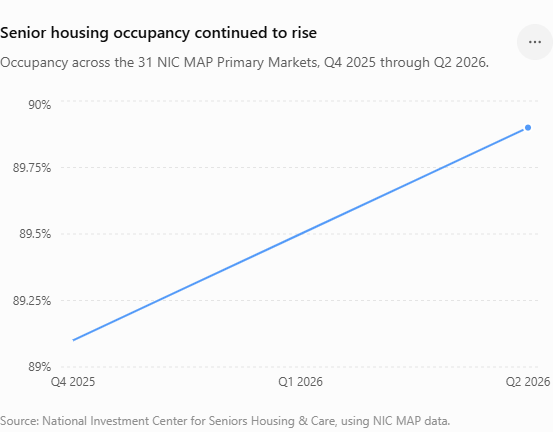
Figure 1. Senior housing occupancy in NIC MAP Primary Markets rose from 89.1% in Q4 2025 to 89.9% in Q2 2026. Source: National Investment Center for Seniors Housing & Care, using NIC MAP data.
The industry may be moving in the right direction while an individual property moves the other way. Executives need both views.
Why Occupancy Usually Moves Last
The basic census equation is simple:
Ending occupied units = Beginning occupied units + Move-ins – Move-outs
What produces those move-ins and move-outs is not simple.
Move-ins begin when a family discovers a community, decides whether it appears trustworthy, gets answers, speaks with someone, tours, and gains enough confidence to act. Move-outs are often preceded by complaints, inconsistent service, leadership instability, staffing strain, or unmet expectations.
That creates three layers of information:
- Demand signals: Can the right families find the community, and do they trust what they see?
- Conversion signals: Does the community make it easy to get answers, schedule a tour, and move forward?
- Retention and operating signals: Does the resident experience match the promise that was made?
Occupancy is the result of all three. Looking only at census is like looking only at a bank balance without reviewing revenue, expenses, or cash flow.
Seven Warning Signs to Track Before Occupancy Drops
1. Local Search Visibility Is Shrinking
Families cannot consider a community they do not find. A decline in search visibility can therefore become an occupancy problem long before it appears in the census report.
Executives do not need to become search specialists, but they should expect a market-level report showing:
- Impressions and clicks for high-intent, nonbranded service-and-location searches
- Google Business Profile views, calls, website visits, and direction requests
- Traffic to pricing, care-level, availability, and tour pages
- Change from the previous period and the same period last year
One weak month is not necessarily a crisis. A sustained decline across related measures means fewer families may be entering the decision process, even if occupancy has not changed yet.
2. Review Velocity or Sentiment Is Weakening
The average star rating matters, but it is not enough. Executives should also know how frequently reviews appear, how quickly the organization responds, and which themes are becoming more common. BrightLocal’s 2026 consumer research found that 74% of consumers focused on reviews written within the previous 90 days, while 45% had used AI tools for local-business recommendations during the prior year. The research was not specific to senior living, but it illustrates the environment in which families evaluate local providers.
AI summaries can make repeated themes easier to see. If multiple reviews mention slow communication, staffing, dining, cleanliness, or inattentive care, the issue can become part of the community’s public reputation.
Track:
- New reviews per month and days since the last review
- Rating, response rate, and response time by platform
- Repeated themes and changes after leadership, staffing, or program changes
The goal is not to manufacture more positive reviews. It is to find and fix the experiences people are already describing.
3. Families Encounter Too Much Decision Friction
Many communities still require a form or sales call before providing basic information. That is increasingly out of step with how people research.
Pricing ranges, care levels, fees, availability processes, dining, activities, staffing, and next steps should be clear enough for a family to determine whether a conversation makes sense. Hiding useful details may simply remove the community from consideration.
This content also supports AI-assisted search. Google says there are no separate technical requirements for its AI features: the fundamentals remain useful content, crawlable pages, clear internal links, current business information, and structured data that matches the visible page.
Useful questions for an executive review include:
- Can a family understand care options, pricing, and fees without calling?
- Does the website answer the questions sales hears every day?
- Is important information written as readable text rather than buried inside an image, video, or download?
- Are location, service, and contact details consistent everywhere?
4. Conversion Is Falling Before Lead Volume Falls
Not every occupancy problem begins with too few inquiries. Sometimes the same number of families enter the pipeline, but fewer progress.
That is why leaders should review the full path:
- Inquiry response time
- Contact rate and inquiry-to-tour conversion
- Tour show rate and tour-to-deposit conversion
- Deposit-to-move-in conversion and time between stages
- Lost-lead reasons
Portfolio totals can hide property-level breakdowns. Before increasing the advertising budget, locate exactly where conversion changed. More leads sent into a broken process usually create more waste, not more move-ins.
5. The Community Is Losing Its Competitive Position
Senior living is intensely local. A community is rarely competing against every provider in a state; it is competing against the small group of realistic alternatives a family will tour.
A quarterly competitive review should look beyond an amenities checklist. Compare:
- Pricing ranges, entrance fees, and common add-on charges
- Care capabilities, limitations, and common add-on charges
- Review recency, recurring themes, and response speed
- Dining, activities, transportation, wellness, and family communication
- Property condition and how clearly each competitor explains its difference
When every community lists similar amenities, families remember whether the community understood their concerns, answered honestly, and created confidence that the resident would have a better life there.
6. The Pipeline Depends Too Heavily on One Outside Source
Third-party referral sources can be valuable. Dependence is the risk.
If one aggregator, hospital relationship, placement agency, or paid channel supplies most prospects, an algorithm or contract change can weaken the pipeline quickly. The community may also be paying acquisition costs without knowing whether those residents stay long enough to produce an acceptable return.
Executives should know:
- Percentage of inquiries and move-ins by source
- Cost, conversion, and 90-day retention by source
- Discounts, referral fees, and other acquisition costs
- What would happen if the largest source declined by 25% or disappeared
Referral relationships should complement an owned growth system, not substitute for one.
7. Staffing and Resident Experience Are Sending the Same Warning
Marketing can generate interest, but it cannot permanently outspend an operating problem.
Declining occupancy is often connected to what happens inside the building: leadership turnover, staffing gaps, inconsistent service, poor communication, weak onboarding, dining dissatisfaction, limited programming, care concerns, or a disconnect between what sales promised and operations delivered.
Review these measures alongside pipeline data:
- Move-outs within 30 and 90 days, including reasons
- Complaints, grievances, and recurring family concerns
- Staff turnover, open positions, call-offs, overtime, and agency use
- Leadership vacancies, missed services, and recurring care-delivery problems
- Resident and family satisfaction trends
- Relevant hospital-transfer, incident, or clinical trends
If review sentiment, early move-outs, and workforce instability all weaken together, the solution is unlikely to be another advertising campaign.
A Practical Senior Living Occupancy Early-Warning Dashboard
The dashboard does not need dozens of measures. It needs a small number of connected measures that show where performance is changing.
| Layer | Measures to Review | Executive Question |
|---|---|---|
| Demand | Search visibility, map interactions, review velocity, direct inquiries | Can families find and trust us? |
| Conversion | Response time, contact rate, inquiry-to-tour, tour-to-move-in | Are we making it easy to move forward? |
| Retention | Early move-outs, move-out reasons, complaints, satisfaction | Does the experience match the promise? |
| Operations | Staffing stability, leadership gaps, missed services, clinical or service trends | Can the team consistently deliver? |
| Financial | Revenue per occupied unit, acquisition cost, discounting, referral-source concentration | Is occupancy producing durable value? |
Community and sales leaders may review operating measures weekly. The executive team should review the combined dashboard at least monthly and examine competitive position quarterly.
There is no universal percentage decline that should trigger the same response in every market. A more useful rule is to escalate when:
- A measure worsens for two consecutive review periods
- Two connected measures weaken at the same time
- A leading indicator and a lagging indicator confirm the same problem
- One property begins moving materially differently from comparable properties
This prevents leaders from overreacting to a single unusual month while making it harder to ignore a developing pattern.
The Financial Effect of Waiting
Small census changes become significant quickly.
For example:
5 avoidable vacancies x $6,000 in monthly revenue x 12 months = $360,000 in annualized gross revenue at risk
That example does not include referral fees, discounts, overtime, turnover costs, or the additional expense of trying to rebuild demand after a reputation problem becomes visible.
The cost of waiting is not simply the empty unit. It is the larger and more expensive intervention required once several warning signs have become a census problem.
What to Do Before Increasing the Marketing Budget
When occupancy or pipeline performance begins to drift, use a disciplined diagnostic process:
- Validate the data. Confirm that inquiries, tours, move-ins, move-outs, and referral sources are being recorded consistently.
- Locate the break. Determine whether the main problem is discovery, response, conversion, retention, or operating capacity.
- Compare properties and competitors. Look for differences that explain why one location is gaining while another is falling.
- Trace external signals back to operations. Reviews and lost-lead comments often identify service, staffing, communication, or leadership problems.
- Correct the highest-leverage failure first. Do not launch five unrelated initiatives when one broken handoff or leadership gap is driving most of the loss.
- Assign an owner and a date. Every corrective action should have a responsible leader, a deadline, and a measure that confirms whether it worked.
This turns occupancy management from a monthly explanation into an operating discipline.
When the Occupancy Problem Is Really an Operating Problem
Some warning signs belong primarily to marketing and sales. Others reveal a deeper organizational issue.
When the underlying cause is leadership instability, staffing, clinical performance, workflow design, resident experience, or a lack of accountability across departments, Gravity Consulting helps senior living organizations determine what is actually failing and put a workable correction in place.
That may include an independent operational or clinical assessment, interim leadership support, team restructuring, process redesign, staff education, performance monitoring, or implementation support. The goal is not to produce another report. It is to stabilize the operation so the experience families find online, encounter during the sales process, and receive after move-in tells one consistent story.
Frequently Asked Questions About Senior Living Occupancy
Senior living occupancy can decline because of lower local demand, weak search visibility, reputation problems, slow inquiry response, poor tour conversion, uncompetitive pricing, excessive dependence on referral sources, preventable move-outs, staffing instability, or service and care concerns. The cause is often a combination of demand, conversion, and retention problems rather than one isolated issue.
There is no single best indicator. The most useful view combines search visibility, direct inquiries, inquiry-to-tour conversion, tour-to-move-in conversion, scheduled move-ins, early move-outs, and staffing or resident-experience trends. When two or more connected measures weaken together, leaders have a stronger signal that future occupancy is at risk.
Many occupancy problems can be detected weeks or months before census falls. The exact lead time depends on the community’s sales cycle and resident turnover. Search impressions, review activity, inquiry volume, response time, scheduled tours, deposits, staffing changes, complaints, and move-out notices can all move before the monthly occupancy rate.
Community teams should generally review inquiries, response, tours, scheduled move-ins, and move-outs weekly. Executives should review the combined demand, conversion, retention, operating, and financial dashboard at least monthly. Competitive pricing, positioning, and secret-shop findings should be refreshed at least quarterly or whenever a new competitor or material market change appears.
Yes. Communities can often improve performance by responding faster, answering pricing and care questions clearly, improving follow-up, fixing tour handoffs, reducing early move-outs, addressing recurring service complaints, strengthening leadership accountability, and improving local search and review fundamentals. Additional advertising should follow a diagnosis, not replace one.
Reviews influence whether families trust and contact a community, and repeated themes can also shape summaries produced by search and AI tools. Review velocity, recency, responses, and sentiment should be tracked as operating signals—not merely marketing metrics. The most durable review strategy is to improve the underlying resident and family experience.
Publish accurate, useful, conversational content that answers real family questions about care, pricing, services, location, eligibility, and next steps. Keep business profiles and directory information current, make important content available as readable text, use clear internal links, and ensure structured data matches the visible page. Google says no special AI-only optimization is required beyond strong search fundamentals.
High occupancy describes current utilization, not future demand or operating strength. A community may remain full because of a strong market, limited new supply, a temporary reduction in move-outs, or one dominant referral source even while visibility, conversion, reputation, staffing, or retention is weakening. Leading indicators show whether today’s occupancy is likely to hold.
Do Not Wait for Census to Confirm What the Other Metrics Already Show
Occupancy problems rarely begin in the census report. They show up earlier in search results, reviews, unanswered inquiries, lost tours, strained staff, family complaints, and early move-outs.
Leaders who connect those signals can intervene sooner, protect more revenue, and avoid treating every decline as a request for more leads. If your organization is seeing occupancy drift—or if the pipeline looks stable while the operating signals do not—start a conversation with Gravity Consulting. We can help determine whether the root cause is leadership, staffing, clinical performance, service delivery, workflow, or a combination of issues, and help put the correction into practice.