Estimated reading time: 11 minutes
Therapy for fall prevention in long-term care is not appropriate after every fall. But when a resident falls three times in one month and the therapy team repeatedly says there is nothing more it can do, leadership should take a closer look.
Each time nursing raises the concern, the response is some version of the same answer:
“There really isn’t anything else we can do.”
Maybe the resident has already received therapy. Maybe they have dementia and struggle to carry over instructions. Maybe the therapist has tried the most familiar interventions without seeing the results they expected.
Whatever the reason, the resident falls again, another incident report is completed, and the same conversation starts over.
How often does this happen in your community?
We recently asked leaders to take a closer look at their LTC therapy utilization. That number can reveal whether long-term care residents may be getting overlooked.
But utilization is only part of the story.
Another important question is what happens when a resident has a legitimate concern—such as repeated falls—and therapy says there is nothing more it can do.
Therapy for Fall Prevention in Long-Term Care: Does Every Fall Require Treatment?
No. A fall by itself does not mean a resident qualifies for skilled therapy.
Therapy cannot eliminate every fall, and some residents will continue to fall despite appropriate interventions. The goal should never be to manufacture a caseload, provide unnecessary visits, or pressure therapists to treat residents without a legitimate skilled need.
However, repeated falls should prompt a thoughtful, interdisciplinary conversation about what is happening and whether all appropriate avenues have been explored.
The AHRQ Falls Management Program was developed specifically for nursing facilities and emphasizes individualized, person-centered care rather than a one-size-fits-all response to falls.
Repeated falls should trigger a comprehensive interdisciplinary response, and skilled therapy should often be one of the first clinical resources considered. Physical, occupational, and—when cognition or communication is contributing—speech therapy can frequently identify modifiable factors that are not apparent from the incident report alone. Nursing, medical providers, pharmacy, environmental services, caregivers, and other disciplines may also play essential roles, particularly when medications, acute illness, environmental conditions, or other medical factors contribute to the fall.
Leadership should feel comfortable asking:
Is there truly no appropriate therapeutic opportunity, or does the clinician need additional support to identify one?
That is not the same as demanding that therapy pick up the resident. It is asking whether the conclusion was reached through a comprehensive clinical review rather than after the most obvious interventions were exhausted.
What Does “There’s Nothing More We Can Do” Really Mean?
Most therapists care deeply about their residents. They also take their professional and ethical responsibilities seriously.
We frequently hear therapists say something like:
“It’s my license, and I’m not going to commit fraud.”
That concern is legitimate. No clinician should provide services that are unnecessary, cannot be supported by the resident’s condition, or do not require skilled care.
But sometimes that statement does not mean the resident has no legitimate therapeutic needs. It means the therapist does not currently see a skilled, defensible treatment pathway.
The therapist may have tried the approaches they know. They may not be sure how to establish meaningful goals for a resident with dementia, limited carryover, chronic decline, or complex medical needs. The therapist may have tried the approaches they know. They may not be sure how to establish meaningful goals or identify an effective treatment pathway for a resident with dementia, limited carryover, chronic decline, repeated falls, or complex medical needs. These are not entry-level therapy problems. Even experienced clinicians may not have received the advanced geriatric training, evidence-based fall-prevention education, or clinical mentorship necessary to recognize and treat the less obvious causes of repeated falls.
In our experience, therapists often are not refusing to help. They simply do not know what else they could appropriately do for that particular resident.
That is where clinical mentorship becomes important.
The answer is not to push more visits. It is to give frontline therapists additional evidence-based tools, experienced clinical guidance, and the confidence to recognize when a legitimate treatment opportunity exists.
Can Therapy Help a Resident With Significant Impairment and Repeated Falls?
Yes. A resident can have significant physical or cognitive impairment, chronic decline, dementia, or a long history of falls and still have needs that can be appropriately addressed through skilled therapy. Even a resident who has already received multiple previous courses of therapy may have a new or different skilled need when the circumstances surrounding the falls change.
The challenge is that complex fall prevention often requires more than repeating the same strength, balance, gait, or transfer interventions that were tried previously. The clinician must determine why this particular resident is falling now and whether a modifiable factor can be addressed through skilled physical, occupational, or speech therapy.
“I spent nearly 15 years as a frontline occupational therapist in senior living, and it took much of my clinical career to develop the depth of knowledge needed to manage the most difficult fall cases. Effective fall prevention requires looking far beyond leg strength and mobility. The breakthrough is often in the details—what the resident was trying to do when they fell, their cognition and how that affects their fall risk, routines, toileting needs, wheelchair setup, positioning, environment, caregiver approach, fear of falling, and recent functional changes.”
— Melissa Brown, OTR/L, RAC-CT, CDP, CSRS
The real question is not whether the resident is significantly impaired or has received therapy before. It is whether the resident has a current need that can be appropriately addressed through skilled therapy—and whether the clinician has the knowledge, tools, and support to recognize it.
How Therapy Can Address Repeated Falls in Long-Term Care
Repeated falls are rarely as simple as weak legs.
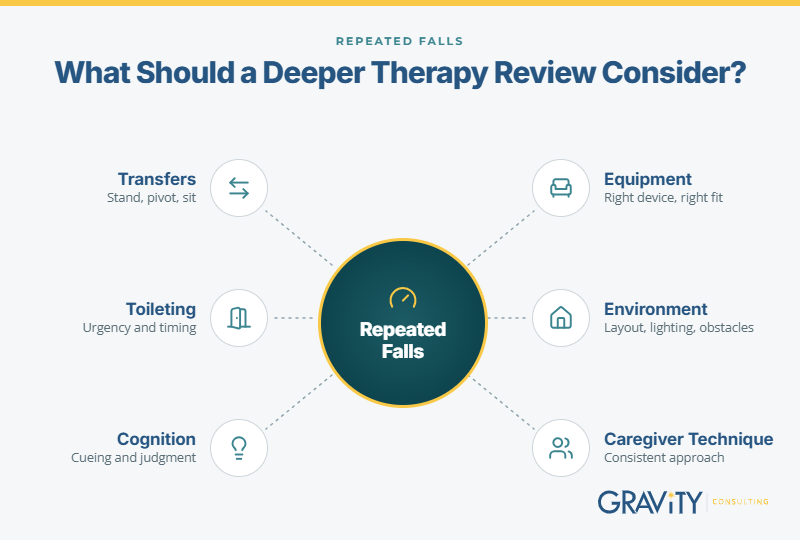
Effective therapy for fall prevention in long-term care requires more than routine strength or balance training. Physical therapy, occupational therapy, and sometimes speech therapy may need to evaluate the resident’s routines, cognitive factors, reasons for unassisted transfers, equipment use and appropriateness, environmental factors, wheelchair positionng and comfort, caregiver approach, and the circumstances surrounding the falls together.
A deeper therapy evaluation after a fall may consider:
- What was the resident attempting to do when the fall occurred? Understanding the purpose behind the movement can reveal the actual problem that needs to be solved.
- Wheelchair mobility and independence: Is the resident repeatedly standing because they cannot independently propel their wheelchair to reach what they need? Would wheelchair-propulsion training reduce unnecessary attempts to walk unassisted?
- Seating, positioning, and comfort: Is the resident uncomfortable or poorly positioned in the wheelchair? Would an advanced cushion, seating intervention, or positioning program reduce attempts to stand because of pain or pressure?
- Wheelchair configuration: Would a lower seat-to-floor height allow the resident’s feet to contact the floor, improve independent foot propulsion, or reduce sliding and unsafe attempts to reposition?
- Toileting routines and urgency: Is the resident getting up because they need to use the bathroom but have difficulty communicating the need? Could a toileting program or other interdisciplinary intervention address the underlying trigger?
- Cognitive status and cueing: Could speech therapy help develop individualized cognitive strategies to improve the resident’s ability to request assistance, remember an assistive device, follow a safer routine, or use wheelchair mobility rather than attempting an unsafe transfer?
- Fear of falling: Is fear changing the resident’s movement patterns, activity level, or confidence? Concern about falling is itself associated with future fall risk per research and should be assessed rather than dismissed as simply anxiety.
- Changes in behavior: Has new agitation, impulsivity, wandering, restlessness, or another behavioral change appeared, and what is driving that change?
- Environmental triggers: Is the room arrangement, furniture, lighting, floor surface, access to personal items, or another environmental factor contributing to unsafe movement?
- Staff techniques and consistency: Are different caregivers transferring, cueing, positioning, or assisting the resident differently?
- Recent mobility or ADL decline: Are the falls part of a broader deterioration in transfers, walking, dressing, toileting, balance, endurance, positioning, or other daily function that should be addressed comprehensively by the therapy team?
- Medical or medication changes: Is there evidence that a new medical condition, medication, orthostatic issue, pain, infection, or other clinical factor requires nursing, medical, or pharmacy intervention?
Physical therapy for fall prevention may evaluate strength, balance, gait, mobility, transfers, fear of falling, movement patterns, and equipment needs.
Occupational therapy for fall prevention may examine ADLs, routines, cognition, environmental factors, wheelchair mobility and positioning, caregiver techniques, and how the resident interacts with their surroundings.
Speech therapy may also play an important role when cognition contributes to the resident’s falls, developing individualized cognitive and communication strategies to help the resident request assistance, follow safer routines, use an assistive device, or remember an alternative such as wheelchair mobility.
No therapy discipline can promise to prevent every future fall. But PT, OT, and SLP can contribute different clinical perspectives that go far beyond simply asking whether the resident is weak.
A routine screen may identify the obvious problems; complex long-term-care residents sometimes require a clinician with advanced fall-prevention expertise to identify the less obvious causes and develop a workable solution.
Can Residents With Dementia Benefit From Skilled Therapy?
Dementia or limited carryover does not automatically mean that therapy has nothing to offer, particularly when repeated falls or functional decline are occurring.
A resident may not remember traditional instructions from one session to the next, but that does not rule out skilled interventions involving task-specific practice, repetition, caregiver training, environmental modification, positioning, cueing strategies, equipment, or familiar daily routines.
Residents with dementia often require substantially more repetition and consistent task-specific practice—not less—because learning and carryover may occur differently and more slowly. Rather than concluding that a resident “cannot carry over,” the therapy team should determine whether the treatment approach, dose of practice, environmental cues, caregiver consistency, and opportunity for repetition are appropriate for that individual.
The important question is not simply whether the resident can recall what the therapist taught them.
The clinical team should consider:
- Can the resident participate in a functional task with the right approach?
- Could staff use a more effective or consistent cueing method?
- Is the environment contributing to unsafe behavior?
- Could seating, positioning, or equipment be improved?
- Could caregiver training make a transfer or ADL safer?
- Is there a measurable outcome that requires skilled clinical judgment?
There will still be residents for whom skilled therapy is not appropriate. But “they have dementia” or “they won’t carry anything over” should not function as automatic disqualifiers without a more complete review.
Why Clinical Mentorship Strengthens Long-Term Care Fall Prevention
Therapy for fall prevention in long-term care is strongest when frontline clinicians can discuss difficult cases with experienced mentors who understand both clinical practice and coverage requirements.
Many therapy management programs focus heavily on numbers:
- Productivity
- Visits
- Labor
- Revenue
- Utilization
Those numbers matter. They can reveal that a community’s LTC therapy utilization is unusually low or that residents experiencing repeated decline are not reaching therapy.
But a utilization report cannot sit beside a frontline therapist and help them think through a complicated resident.
It cannot help the therapist reconsider the resident’s goals, apply a different evidence-based strategy, or determine whether a skilled need has been overlooked.
This is part of a broader question every operator should be asking: Therapy may be covered, but is it actually working for your building?
A full schedule and acceptable productivity numbers do not necessarily mean a therapy department has the clinical depth to manage complex long-term care residents.
That requires clinical mentorship.
Strong mentorship helps therapists:
- Work through difficult LTC cases
- Apply evidence-based strategies in real-world settings
- Identify meaningful and realistic outcomes
- Recognize when skilled therapy is appropriate
- Recognize when therapy is not appropriate
- Strengthen clinical reasoning and documentation
- Practice at the top of their license
The goal is not to persuade therapists to treat residents who do not qualify.
The goal is to ensure residents who genuinely need and qualify for therapy are not overlooked because the clinician has run out of familiar options.
A Fall-Prevention Gut Check for Leadership
Review the residents in your community who have fallen repeatedly during the past 30 to 60 days.
Ask:
- How many received a thoughtful therapy review?
- What reasons were given when therapy was not recommended?
- Do phrases such as “no potential,” “won’t carry over,” or “nothing else we can do” come up frequently?
- Can the therapy team explain what factors were considered?
- Were both physical and occupational therapy perspectives considered when appropriate?
- Was speech therapy consulted when cognition, communication, memory, sequencing, or safety awareness may be contributing to the resident’s falls—and could individualized cognitive strategies help?
- Who does a frontline therapist call when they are unsure how to approach a difficult resident?
- Does your therapy model provide meaningful clinical mentorship, or does it primarily measure operational performance?
You should not expect therapy to eliminate every fall.
You should expect a therapy program capable of looking beyond the obvious, supporting its clinicians, and identifying appropriate opportunities to improve residents’ safety, function, and quality of life.
Therapy for fall prevention in long-term care should never be used to justify unnecessary visits. It should help ensure that residents with a legitimate skilled need are not overlooked because the first or most familiar interventions did not work.
Residents should never receive therapy simply because they have fallen. But they also should not miss care they genuinely need and qualify for because the clinician does not yet see a legitimate path forward.
Gravity’s Hybrid Therapy model combines operational oversight with best-in-class clinical mentorship. We help frontline therapists strengthen their clinical reasoning, apply evidence-based strategies, and recognize appropriate opportunities to make a meaningful difference in residents’ lives.
Take a closer look at how your therapy program responds to repeated falls and complex long-term care residents.